Same engines
The native runners themselves
Fornax calls llama.cpp, stable-diffusion.cpp, acestep.cpp, yue2.cpp, whisper.cpp and stems.cpp directly: the same C/C++ engines the CLIs and servers use, so you get their speed and their model support.

Open generative models for the JVM
Call models as plain Java methods, on your GPU, inside your JVM.
NewWatch · 2:31: Fornax in two minutesEarly · Apache 2.0 · a Liberation Data project · Download Fornax Studio
Zero overhead
Straight from the JVM to the GPU.
Fornax runs open-weight models in-process, through Java’s Foreign Function & Memory API: language and vision models, speech, images, songs and video, for business, industrial, medical and creative work, or anywhere a specialized model earns its keep. A model is an object, a generation is a method call, and the weights stay on your GPU between calls. There is no Python, no model server, no HTTP, no JSON round trip and no second process.

Fornax in two minutes: open generative models inside your JVM. With captions.
Same engines
Fornax calls llama.cpp, stable-diffusion.cpp, acestep.cpp, yue2.cpp, whisper.cpp and stems.cpp directly: the same C/C++ engines the CLIs and servers use, so you get their speed and their model support.
Vulkan today
Vulkan on AMD, Intel and NVIDIA. The same build script knows ROCm, CUDA and Metal, and your Java code doesn’t change when you switch.
One process
A Fornax call is a native function call. Weights stay resident between calls, and tokens stream back to a Java callback as they are produced.
Plain Java API
Open a model in a try-with-resources block, call it as often as you like, and close it to give the memory back.
AutoCloseable: weights are freed on close().System.out::print.chatJson: OpenAI-style messages and tools in, tool_calls out.BufferedImage.// The weights load onto the GPU once, and stay there until close()
try (var llm = new LlamaModel("Qwen3-4B-Instruct-2507-Q4_K_M.gguf")) {
// Tokens stream to your callback as they are produced
llm.chat(List.of(Message.user("Name a country song about a robot.")),
Options.DEFAULT, System.out::print);
}// OpenAI-style messages and tools in, an OpenAI-style message out
String res = llm.chatJson("""
{"messages": [{"role": "user",
"content": "What's the weather in Nashville right now?"}],
"tools": [{"type": "function", "function": {
"name": "get_weather", "description": "Current weather for a city",
"parameters": {"type": "object",
"properties": {"city": {"type": "string"}},
"required": ["city"]}}}],
"temperature": 0, "max_tokens": 128, "seed": 1}""",
null); // or a callback, to stream
// res has content, reasoning_content and tool_calls:
// here, finish_reason "tool_calls" and get_weather for Nashvilletry (var songs = new AceStepModel(lm, textEncoder, dit, vae, true)) {
songs.generate(requestJson).audio().writeWav(new File("song.wav"));
}try (var images = new DiffusionModel(DiffusionModel.Config.builder()
.diffusionModel(flux).vae(vae).llm(textEncoder).build())) {
BufferedImage img = images.generate(
new DiffusionModel.Request("a neon sign", 1024, 1024, 20, 4.0, 7)).get(0);
}Fornax doesn’t download anything: HfCache finds weights in your Hugging Face cache, or pass file paths.
Engines and models
Each module binds one engine. Use one, or put several in the same JVM.
Text
on llama.cpp
Any GGUF language model, vision models that read images, and embeddings and reranking for search.
Speech
on llama.cpp
Text to speech, with built-in voices or a reference clip.
Images
Diffusion models, including image editing.
Songs
on acestep.cpp
Songs with vocals and lyrics, up to several minutes long.
Songs
on yue2.cpp
Songs, from the engine’s own JSON request.
Transcripts
on whisper.cpp
Speech to text, with a start and end for every word.
Stems
on stems.cpp
A song split into vocals and backing, or drums, bass, other and vocals.
Check each model’s license before you use what it makes. Some are non-commercial: YuE2’s weights are CC BY-NC 4.0, for example.
Measured
Everything here ran from Java on Linux, on an AMD Radeon 8060S (Ryzen AI Max+ 395 “Strix Halo”, 128 GB unified memory) with the Vulkan backend.
Backends:
The build script knows the ROCm, CUDA and Metal backends of the underlying engines, but those Fornax builds haven’t been tested yet. Reports and fixes welcome.
| Model | Result |
|---|---|
| Qwen3 4B Instruct (Q4_K_M) | ~60 tokens/s |
| ACE-Step 1.5 XL turbo | 3 min 20 s song in 57 s |
| ACE-Step 1.5 turbo | 60 s song in ~15 s |
| YuE2 3B (Q8_0) | 60 s song in ~60 s |
| FLUX.2 [klein] base 4B (fp8) | 768×768, 12 steps in ~130 s |
| Qwen-Image 2512 (fp8) | 1024×1024, 20 steps in ~13 min |
| Whisper large-v3-turbo (q5_0) | 55 s of speech in 1.8 s, timed word by word |
| HTDemucs v4 | 3 min 9 s song into four stems in 26 s |
Against ComfyUI
ACE-Step 1.5 turbo with its 4B LM, writing a 60 s song, on the same machine. Cold is the first run with nothing loaded, weights included. Warm is the second run with the weights resident (seed + 1, so ComfyUI doesn’t return its cached result).
Not quite like for like: ComfyUI ran the bf16 safetensors DiT, Fornax the GGUF Q8_0 weights. One run each, from fornax-bench.
Fornax Studio
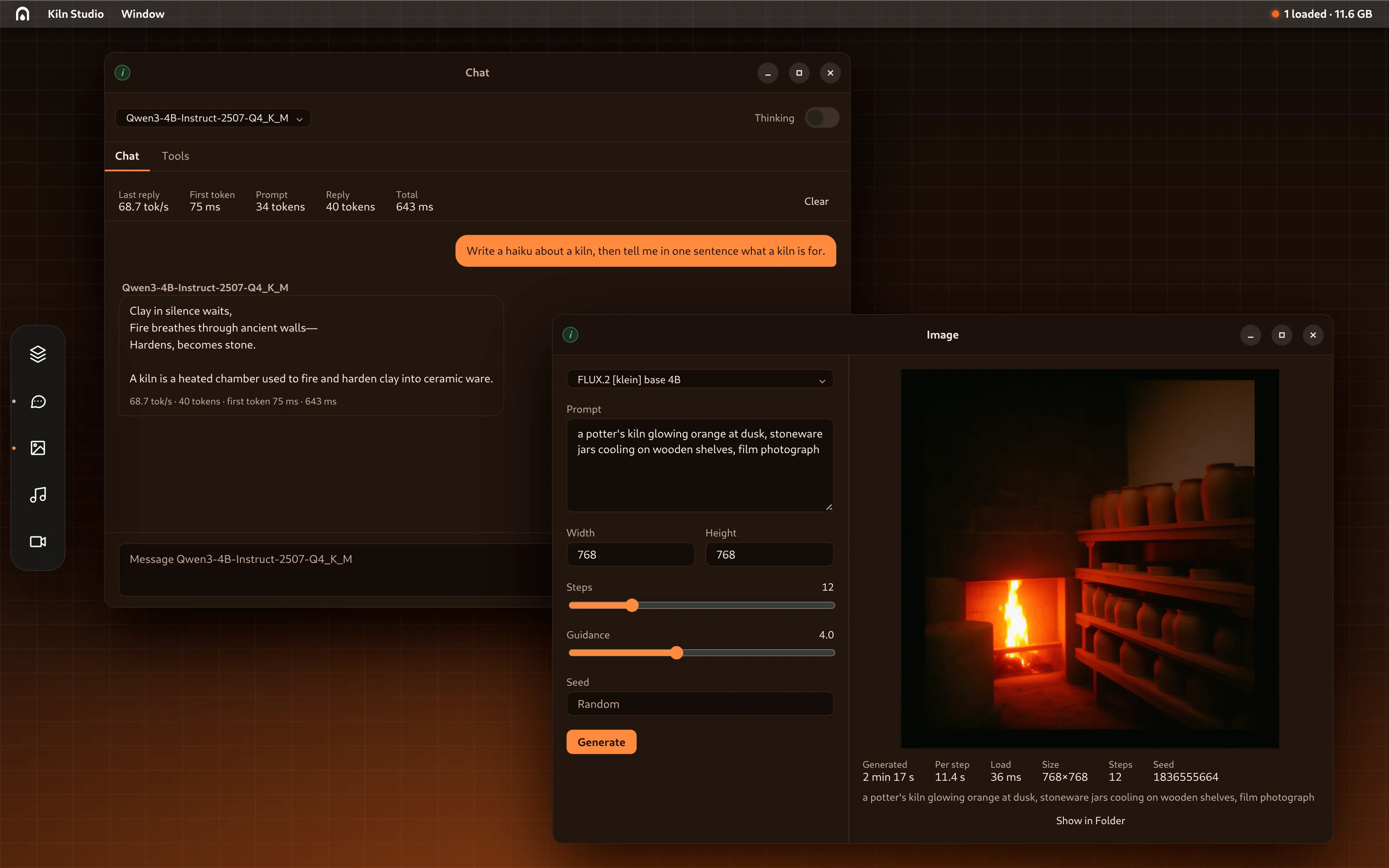
Fornax Studio is a desktop app around Fornax: chat with a GGUF model and watch the tokens per second, watch it call tools, make an image or a song, and see what is loaded and how much memory it holds. It runs Fornax in a JVM of its own, with its own Java, and finds the models in your Hugging Face cache.
Download Fornax Studio.Alpha 0.1.0. Models are not included: fetch them with fornax pull or the Hugging Face CLI, as in Getting started. The macOS builds are signed and notarized, so they open without a Gatekeeper prompt.
Open the .dmg and drag Fornax Studio to Applications.
Or paste one of these into a terminal: it fetches the package and installs it (a software-centre double-click can't open a local package). Needs your GPU's Vulkan driver.
Every release, and its notes, are on GitHub.
How it works
Each engine is built into a single shared library with its own ggml linked in statically and kept private. The engines pin different ggml versions, and this is what lets several of them share one process.
Has a key/value C API, so fornax-sd binds it directly.
Its C API passes structs by value and is mid-migration to a new batch API, so fornax-llama binds a small, stable C layer instead.
C++ only, so each gets a C layer of about a hundred lines: a JSON request in, PCM audio out.
LlamaModel.chatJson takes messages and tools in OpenAI’s format and returns a message with content, reasoning_content and tool_calls. It uses the model’s own chat template and tool-call format, with the same templates and parsers as llama-server.
Keeps models resident between uses, the way ComfyUI does. It unloads idle models least recently used first to stay within a memory budget, can unload after an idle timeout, and gives each model one user at a time.
The Java is the same for every backend. native/build.sh builds the libraries for the one you name.
A long GPU dispatch can trip a laptop driver’s compute timeout, so ACE-Step audio is decoded in 512-frame tiles. Tune it with FORNAX_ACESTEP_VAE_CHUNK.
Set FORNAX_VERBOSE=1 to see what llama.cpp, stable-diffusion.cpp and friends print.
Embabel
Embabel Agent plans with goals and actions on the JVM. Fornax runs local models in the same process: chat and tool calls, vision, embeddings, speech, images, songs and video. Afornax-embabel module, to give Embabel's agents those models, isin progress.
Getting started
Fornax is on Maven Central as org.fornax4j. You need Java 22 or newer (Kiln 0.1.0 itself needs 25), and on Linux your GPU’s Vulkan driver, which desktop installs already have (if not: Installing GPU drivers). Macs need nothing more.
An engine module, and the natives jar for your OS and GPU. Fornax unpacks the engine into its cache and loads it, so there’s no native build. Maven works the same way: see Maven and Gradle.
// build.gradle.kts: an engine module, and the natives jar for the OS and arch building it
val natives = when {
    !System.getProperty("os.name").startsWith("Mac") -> "linux-x86_64-vulkan"
    System.getProperty("os.arch") == "aarch64" -> "macos-aarch64-metal"
    else -> "macos-x86_64-metal"
}
dependencies {
    implementation("org.fornax4j:fornax-llama:0.2.0")
    runtimeOnly("org.fornax4j:fornax-natives-$natives:0.2.0")
}With fornax pull and an alias from Fornax’s catalogue. To get fornax, install Fornax Studio and choose Install fornax command from its menu (coming in the next Studio release), or build it from source with ./gradlew :fornax-cli:installDist. Or use the Hugging Face CLI: both fill the one Hugging Face cache (HF_HUB_CACHE, HF_HOME/hub or ~/.cache/huggingface/hub), where HfCache finds the weights.
fornax pull qwen3-4b
# or, with the Hugging Face CLI:
hf download unsloth/Qwen3-4B-Instruct-2507-GGUF Qwen3-4B-Instruct-2507-Q4_K_M.ggufA chat reply, streamed token by token from your GPU, inside your JVM. samples/hello-fornax is this as a project to copy, for Gradle and Maven.
var weights = HfCache.find("unsloth/Qwen3-4B-Instruct-2507-GGUF",
        "Qwen3-4B-Instruct-2507-Q4_K_M.gguf").orElseThrow();
try (var llm = new LlamaModel(weights.toString())) {
    llm.chat(List.of(Message.user("Write a haiku about a fornax.")),
            Options.DEFAULT, System.out::print);
}
// run with --enable-native-access=ALL-UNNAMEDFor HIP or CUDA, or to run the repository’s examples: JDK 25, CMake, Ninja, a C++17 compiler and your GPU’s SDK. native/build.sh clones the engines at their pinned commits; point your app at the result with -Dfornax.library.path.
native/build.sh vulkan     # or hip | cuda | metal | cpu
./gradlew build
./gradlew single           # an LLM writes a song, ACE-Step sings it, FLUX.2 klein paints the cover
./gradlew image --args='klein out.png "a neon sign that says FORNAX"'
Roadmap
fornax-embabel: an Embabel Agent LlmService and LocalModelSource.mlx-c.Flow streaming.Things on the JVM are about to heat up
Open models as Java objects, on your own GPU. Fornax is early: try it, and tell us what breaks.